Solution Proposal from Mitutoyo
Measuring Instrument Overview


Solution Proposal from Mitutoyo
Measuring Instrument Overview
What is a Coordinate Measuring Machine?
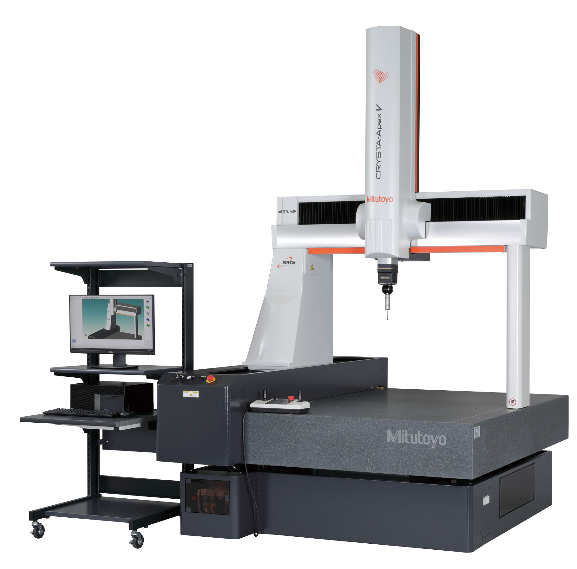
A Coordinate Measuring Machine (CMM) is a precision instrument used to measure the physical geometrical characteristics of an object. It operates by using a probe to contact the surface of the object at various points, recording precise coordinates (X, Y, and Z) for accurate dimensional measurement. The probes used in CMMs can vary depending on the application: a tactile probe makes contact with the object's surface, a scanning probe continuously measures a surface, an optical probe uses light to measure dimensions without physical contact, a laser probe utilizes laser beams for high-speed, non-contact measurement, and a roughness probe is designed to assess the surface texture and roughness. CMMs are widely used in manufacturing and quality control to ensure parts adhere to exact specifications, enabling detailed inspection and detection of defects.
There are different types of CMMs, such as:
• Manual CMM: These require an operator to manually move a probe to the points of interest on the part being measured.
• Motorized or Automated CMM: These are computer-controlled machines that automatically move the probe to the required points on the part, making the process faster and more precise.
• Portable CMM: These are smaller and can be moved to various locations, often used for larger parts or items that cannot be easily placed on a traditional CMM.
Common Applications:
• Inspection and quality control: Ensuring parts meet specifications and tolerances.
• Reverse engineering: Capturing the dimensions of existing parts for reproduction.
• Tooling and fixture design: Verifying that tools and fixtures are built to spec.
Items Measurable with a Coordinate Measuring Machines
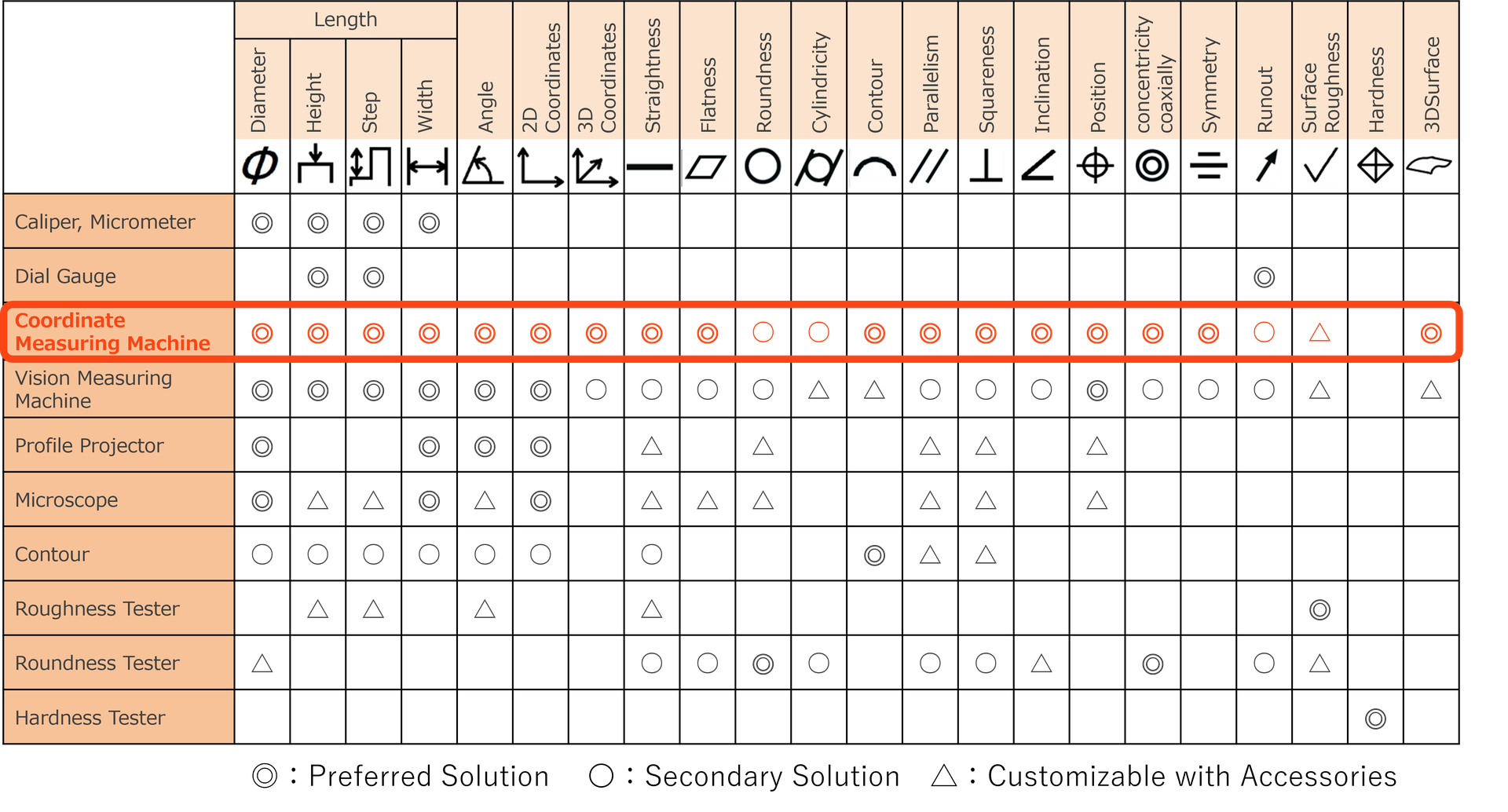
Key Point: A Coordinate Measuring Machine (CMM) can perform a wide range of measurements with a single machine.
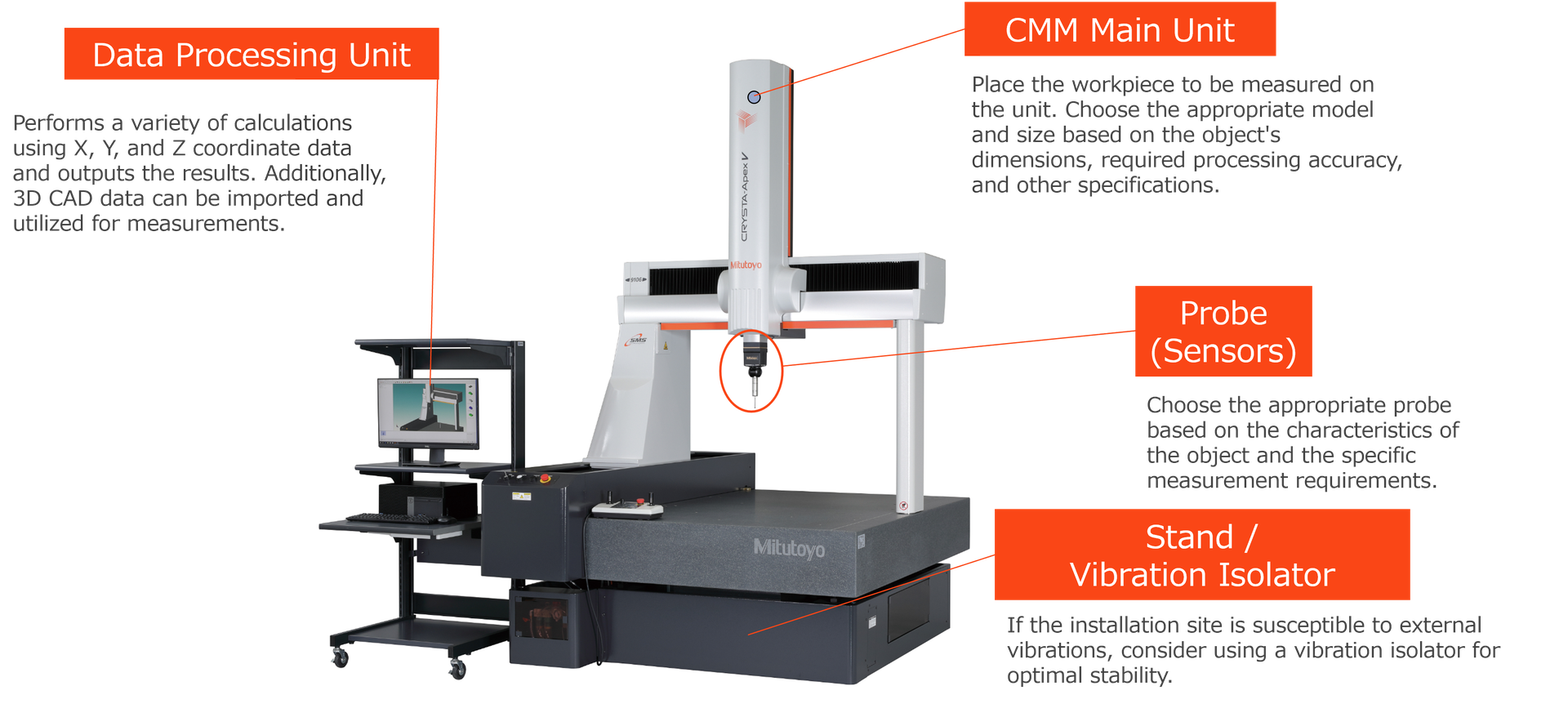
System Configuration
Benefits of Implementation
Points to Consider When Selecting a Model
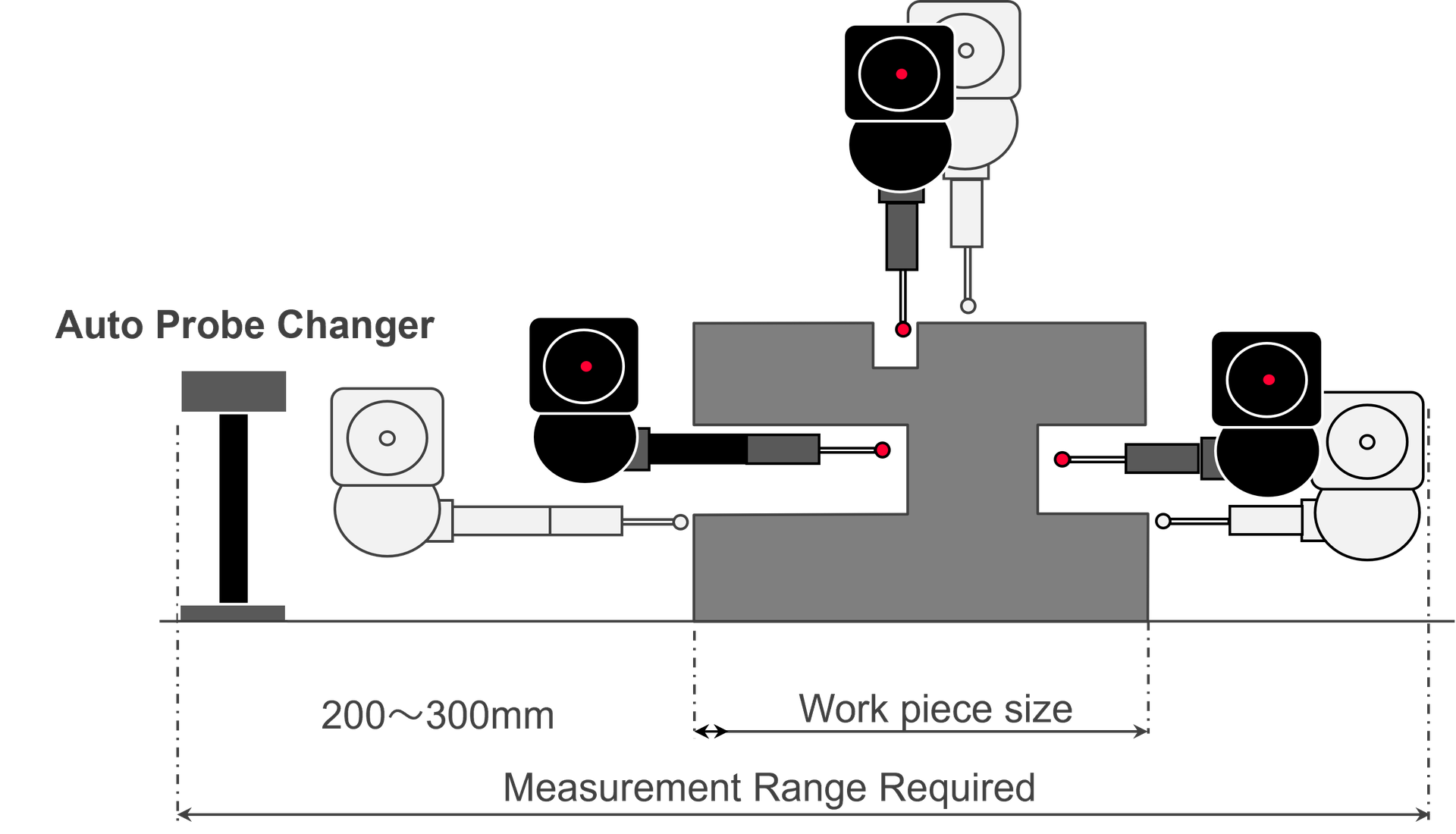
Contact type/non-contact type
Need help solving a measurement problem? Contact us anytime!
Related Solutions and Applications

LEGEX Series - Ultra-High Accuracy CNC Coordinate Measuring Machine
The LEGEX delivers world-class ultra-high measurement accuracy (E0, MPE=0.28+L/1000), achieved by meticulously eliminating and controlling error factors.

CRYSTA-Apex V - General-Purpose CNC Coordinate Measuring Machine
The CRYSTA-Apex V is a standard accuracy, high-speed CNC coordinate measuring machine designed for versatile dimensional and geometric tolerance measurements, offering improved productivity and enhanced visualization within a single unit.

MiSTAR 555 - Shop-Floor Type CNC Coordinate Measuring Machine
The MiSTAR 555 is a compact, shop-floor CNC coordinate measuring machine that ensures high-accuracy performance in challenging environments, including oil mist, with a wide, accuracy-guaranteed temperature range.

Mitutoyo America Corporation. All rights reserved.